


GYTA333 Complete structural definition: Loose-tube stranded cable, metal central reinforcement, fully filled with cable grease, aluminum-plastic bonded inner sheath, double-layer fine round steel wire armor, polyethylene outer sheath, underwater special optical cable.
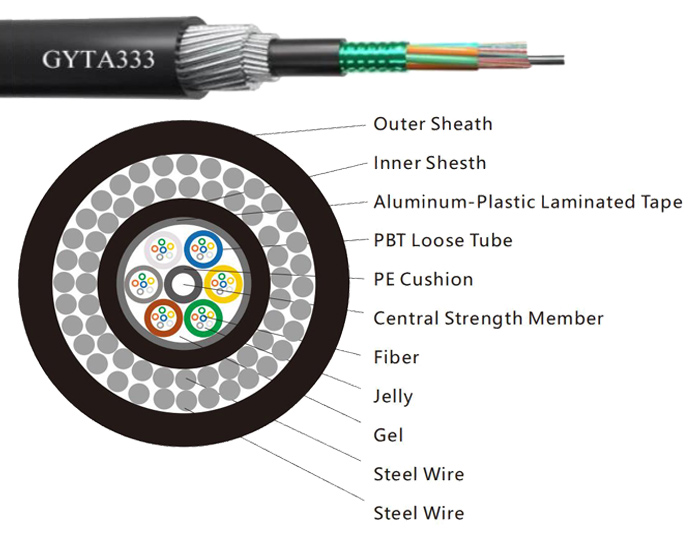
Detailed Explanation of Layered Structure from Inside to Outside
- Fiber Optics: 250μm coated fiber, selectable G.652D, G.657A1/A2 single-mode; OM1/OM2/OM3/OM4 multimode, core count 2-144 (customizable);
- PBT Loose Tube: Fiber optic cable individually housed, filled with fiber grease, providing shock absorption, waterproofing, and moisture isolation;
- Metal Central Reinforcing Core: Phosphated steel wire, the core for tensile strength of the entire system;
- Cable Core Water-Blocking Filler: Loose tube + filler rope SZ stranded into a round cable core, gaps filled with water-blocking grease to prevent longitudinal water seepage;
- APL Coated Aluminum Ribbon Longitudinal Sheath: Radial water-proof and moisture-proof, with basic shielding protection;
- PE Inner Sheath: Aluminum ribbon bonded and formed, providing an isolation armor layer and protection against electrochemical corrosion;
- Double-Layer Fine Round Galvanized Steel Wire Armor: Two layers of independent steel wire winding, providing superior tensile strength, crush resistance, anchor drag resistance, and protection against marine organism bites;
- HDPE Black outer sheath: Resistant to seawater corrosion, UV radiation, high and low temperatures, abrasion and drag, ensuring long-term stable underwater service.
Core Product Advantages (Promotional Selling Points, Suitable for Bold Highlighting on the Official Website)
- Double-layer steel wire armor, maximizing mechanical strength.
Compared to single-layer GYTA33, the double-layer armor achieves short-term tensile strength exceeding 10,000N, providing extremely strong lateral pressure resistance, making it less prone to breakage and flattening in navigable waterways, scourbed riverbeds, and near-shore rock-laying applications;
- Full-link three-dimensional waterproofing, preventing leakage even after long-term seawater immersion.
Four-fold water resistance: fiber optic paste + cable paste + aluminum-plastic waterproof layer + double-layer sheath, providing radial and longitudinal bidirectional water resistance, suitable for near-shore and deep-water laying environments of 10–150 meters;
- Stable transmission over a wide temperature range.
Operating temperature: -40℃~+70℃, suitable for use in cold seas, tropical nearshore areas, and ice-covered rivers in winter;
- Low fiber optic transmission loss and low dispersion.
G.652D Standard 1310nm≤0.36dB/km, 1550nm≤0.22dB/km, eliminating signal attenuation bottlenecks for long-distance underwater communication; Strong resistance to external forces, resisting ship anchor hooks, reef friction, underwater engineering machinery towing, and bites from rodents/marine organisms; Highly adaptable to laying on sloping shores and coastlines with large tidal differences; High laying flexibility, with a static bending radius ≥15 times the cable diameter and a dynamic laying radius ≥30 times the cable diameter, providing high tolerance for errors in underwater cable laying and traction construction.
| Parameter | |
|---|---|
| Fiber cores | 2,4,6,8,12,24,48,72,96,144(Can Custom) |
| Applicable water depth | 10~150m Nearshore, navigable rivers, and lakes underwater |
| Permissible long-term tensile force | ≥4000N |
| Allow short-term tension | ≥10000N |
| Allowable flattening force(100mm) | Long-terms 3000N / Short-terms 5000N |
| Bending radius | static ≥15D;Dynamic laying ≥30D(D = outer diameter of optical cable) |
| Usage / Storage and Transportation Temperature | -40℃ ~ +70℃ |
| Singlemode G.652D attenuation | 1310nm≤0.36dB/km;1550nm≤0.22dB/km |

Precise Application Scenarios: Coastal backhaul communication for near-shore islands, offshore wind power platforms, and marine observation base stations; underwater trunk communication cable laying across rivers, lakes, and navigable waterways; underwater communication links for coastal ports and wharves, and cross-sea bridges; tidal power stations, marine aquaculture area monitoring, and underwater sensor signal transmission; cross-border near-shore short-distance submarine cables and inland waterway communication upgrades; laying scenarios involving steep riverbanks, severely eroded riverbeds, and unstable riverbanks.
Laying Instructions and Packaging: Laying methods: underwater direct burial, underwater placement, trench burial, and riverbank traction; Factory standard length: standard 2km/reel, custom reel lengths supported; Export packaging: iron and wood cable reel + sealing plate for fixation, moisture-proof wrapping film sealing, less prone to impact damage during ocean shipping.
Hot Tags: deep sea fiber optic cable, China deep sea fiber optic cable manufacturers, suppliers


