


Fiber Pigtail
-
![OM3 Fiber Pigtail]() OM3 Fiber PigtailA fiber pigtail is a thin multimode or single-mode fiber optic cable with a connector installed on one end. The purpose of the fiber pigtail is to terminate the fiber in fiber optic systems, so...read more
OM3 Fiber PigtailA fiber pigtail is a thin multimode or single-mode fiber optic cable with a connector installed on one end. The purpose of the fiber pigtail is to terminate the fiber in fiber optic systems, so...read more -
![SC Fiber Pigtail]() SC Fiber PigtailFiber optic pigtail refers to a connector similar to a half jumper used to connect fiber optic and fiber optic couplers, which includes a jumper connector and a section of fiber optic. Or it can...read more
SC Fiber PigtailFiber optic pigtail refers to a connector similar to a half jumper used to connect fiber optic and fiber optic couplers, which includes a jumper connector and a section of fiber optic. Or it can...read more -
![LC Fiber Pigtail]() LC Fiber PigtailLC in optical fiber represents a small connector type tail fiber, which is made using a modular jack (RJ) latch mechanism for easy operation. The size of the pins and sleeves used is half of the...read more
LC Fiber PigtailLC in optical fiber represents a small connector type tail fiber, which is made using a modular jack (RJ) latch mechanism for easy operation. The size of the pins and sleeves used is half of the...read more -
![FC Fiber Pigtail]() FC Fiber PigtailPigtail fiber, also known as pigtail fiber, is the optical fiber used to connect the fiber optic cable terminal box to the equipment. Pigtail fibers are often classified into single mode or...read more
FC Fiber PigtailPigtail fiber, also known as pigtail fiber, is the optical fiber used to connect the fiber optic cable terminal box to the equipment. Pigtail fibers are often classified into single mode or...read more -
![ST Fiber Pigtail]() ST Fiber PigtailPigtail fiber, also known as pigtail wire, has only one end with a connector, while the other end is a broken end of an optical cable core, which is connected to other optical cable cores through...read more
ST Fiber PigtailPigtail fiber, also known as pigtail wire, has only one end with a connector, while the other end is a broken end of an optical cable core, which is connected to other optical cable cores through...read more -
![OM3 Fiber Pigtail]() OM3 Fiber PigtailOM3 Fiber Optical Pigtail is designed for 10G Ethernet transmission. If longer transmission distance is required, OM4 fiber needs to be selected. Additionally, both OM3 and OM4 fiber support...read more
OM3 Fiber PigtailOM3 Fiber Optical Pigtail is designed for 10G Ethernet transmission. If longer transmission distance is required, OM4 fiber needs to be selected. Additionally, both OM3 and OM4 fiber support...read more -
![12 Colors Fiber Pigtail]() 12 Colors Fiber PigtailBundle optical fiber pigtail, a multi-core pigtail contains 12 cores. The 12 Colors Fiber Optical Pigtail are bundled in a fan shape for easy use. One end is welded and the other end is equipped...read more
12 Colors Fiber PigtailBundle optical fiber pigtail, a multi-core pigtail contains 12 cores. The 12 Colors Fiber Optical Pigtail are bundled in a fan shape for easy use. One end is welded and the other end is equipped...read more -
![Single Mode Fiber Pigtail]() Single Mode Fiber PigtailThe single mode tail fiber is yellow, with two wavelengths, 1310nm and 1550nm, and transmission distances of 10km and 40km, respectively. Tail fiber, also known as tail wire, has only one end...read more
Single Mode Fiber PigtailThe single mode tail fiber is yellow, with two wavelengths, 1310nm and 1550nm, and transmission distances of 10km and 40km, respectively. Tail fiber, also known as tail wire, has only one end...read more -
![Multimode Fiber Pigtail]() Multimode Fiber PigtailFiber pigtails are generally distinguished by color for single mode and multimode resolution.read more
Multimode Fiber PigtailFiber pigtails are generally distinguished by color for single mode and multimode resolution.read more

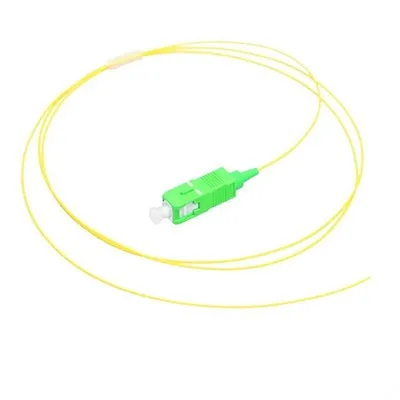


What Is Fiber Pigtail?
A fiber pigtail is a length of fiber optic cable with a connector pre-installed on one end. It is used to connect fiber optic cables together or to connect fiber optic cables to network devices such as switches, routers, or transceivers. Fiber pigtails are commonly used in telecommunications and data center applications to provide a quick and easy way to make fiber optic connections.
Quality transmission
Fiber pigtails ensure high quality transmission of data over long distances with minimal loss of signal.
Low interference
As fiber pigtails are immune to electromagnetic and radio frequency interference, they offer better transmission quality compared to other types of cables.
Wide range of applications
Fiber pigtails are suitable for use in a wide range of applications, including telecommunications, data centers, internet infrastructure and more.
Easy installation
Fiber pigtails are easy to install and can be terminated quickly, making them a popular choice for many industries.
Durability
Fiber pigtails are extremely durable and can withstand harsh environments and weather conditions.
Reduced maintenance
As fiber pigtails do not require regular maintenance, they help reduce operational costs in the long run.
Cost-effective
Although the initial cost of fiber pigtails may be high, they offer value for money as they last a long time without requiring much maintenance.
Fiber pigtails are essential components in the world of high-speed internet connections, enabling the seamless transmission of data at blazing fast speeds. With the increasing demand for faster and more reliable internet connections, fiber pigtails play a crucial role in unleashing the full potential of fiber optic technology.
Fiber pigtails are essentially short segments of fiber optic cable with connectors already terminated on one end. They are used to connect fiber optic cables to various devices such as switches, routers, and patch panels. By utilizing fiber pigtails, data can be transmitted over long distances with minimal signal loss and interference, resulting in faster and more stable internet connections.
One of the key advantages of using fiber pigtails is their ability to support higher bandwidths compared to traditional copper cables. This means that with fiber pigtails, internet service providers can deliver faster download and upload speeds to their customers, enabling them to stream high-definition videos, play online games, and conduct video conferences without any lag or buffering.
Furthermore, fiber pigtails are known for their reliability and durability. Unlike copper cables that are susceptible to electromagnetic interference and signal degradation over long distances, fiber optic cables used in conjunction with fiber pigtails are immune to such issues. This ensures a consistent and reliable internet connection for users, even in environments with high levels of electromagnetic interference.
Fiber pigtails are indispensable for unleashing blazing fast internet speeds in today's digital age. By harnessing the power of fiber optic technology and utilizing fiber pigtails effectively, internet service providers can provide their customers with lightning-fast internet connections that meet the demands of modern-day digital activities. With fiber pigtails paving the way for faster and more reliable internet connections, the future of high-speed internet looks brighter than ever before.

Single-mode fiber pigtail – This type of fiber pigtail is designed to work with single-mode fiber optic cables. It has a small core diameter that allows light to travel in a straight line, which reduces the risk of signal distortion.
Multimode fiber pigtail – Multimode fiber pigtail is used with multimode fiber optic cables. It has a larger core diameter that allows light to travel in multiple pathways, which is suitable for short distance communication.
Simplex fiber pigtail – A simplex fiber pigtail is used for point-to-point communication. The simplex pigtail has one fiber and connector at each end of it.
Duplex fiber pigtail – A duplex fiber pigtail is used for bidirectional communication. It has two fibers and connectors at each end of it.
Ribbon fiber pigtail – A ribbon fiber pigtail is used where a higher density of fiber is required. It has multiple fibers in a ribbon-like shape, which makes it easier to terminate in a connector.
Loose tube fiber pigtail – A loose tube fiber pigtail is designed to protect the fiber from environmental damage. It has a protective outer jacket that envelopes the fiber.
Upgrade Your Network With Fiber Pigtails
Fiber pigtails are essential components for upgrading your network infrastructure to ensure faster and more reliable data transmission. By incorporating fiber pigtails into your network setup, you can significantly enhance the performance and efficiency of your communication systems.
Fiber pigtails serve as connectors between fiber optic cables and network devices, enabling seamless data transfer with minimal signal loss. Compared to traditional copper cables, fiber optic cables used in conjunction with pigtails offer much higher bandwidth capacity, allowing for the transmission of large amounts of data at incredible speeds. This is particularly crucial in today's digital age where the demand for high-speed internet and data connectivity is ever-increasing.
Fiber pigtails are known for their durability and resistance to electromagnetic interference, making them ideal for use in environments where electrical interference is a concern. This ensures a stable and secure network connection, reducing the risk of signal disruptions and downtime.
In addition to performance benefits, incorporating fiber pigtails into your network infrastructure can also future-proof your system. As technology continues to advance, having a fiber-optic network in place will position your organization for seamless integration of new technologies and services without the need for major overhauls.
Upgrading your network with fiber pigtails is a strategic investment that can yield long-term benefits in terms of improved performance, reliability, and scalability. Whether you are looking to enhance the efficiency of your business operations or provide faster internet speeds for your customers, incorporating fiber pigtails into your network infrastructure is a smart choice that will help you stay ahead in today's fast-paced digital landscape.
Maximizing your network potential is essential for staying competitive and efficient. One of the key components in achieving this goal is utilizing advanced connectivity solutions such as fiber pigtails. Fiber pigtails are essential components in fiber optic networks, providing a seamless and reliable connection between different network devices.
Fiber pigtails offer several advantages over traditional copper cables, including higher bandwidth, faster data transmission speeds, and greater reliability. By incorporating fiber pigtails into your network infrastructure, you can significantly enhance your network performance and efficiency.
One of the main benefits of fiber pigtails is their ability to support higher bandwidths, allowing for the transmission of large amounts of data at faster speeds. This is particularly important in today's data-driven environment, where businesses rely on quick and efficient data transfer for their operations.
Fiber pigtails are more resistant to electromagnetic interference and signal degradation compared to copper cables. This means that you can enjoy a more stable and reliable connection with fewer disruptions or downtime.
Fiber pigtails are also more durable and have a longer lifespan than traditional copper cables. This means that you can save on maintenance costs and enjoy a more sustainable network infrastructure in the long run.
Maximizing your network potential with fiber pigtails is a smart investment that can help you stay ahead in today's competitive business landscape. By leveraging the advanced connectivity offered by fiber pigtails, you can enhance your network performance, reliability, and efficiency, ultimately leading to improved productivity and success for your organization.

Choosing the right fiber pigtail is crucial for ensuring a reliable and efficient fiber optic network. Fiber pigtails are essential components that are used to connect fiber optic cables to various devices such as patch panels, switches, and routers. Here are some key factors to consider when choosing fiber pigtails:
Fiber type: The first step in selecting a fiber pigtail is to determine the type of fiber optic cable you are using. Common types include single-mode and multi-mode fibers. Make sure the pigtail you choose matches the fiber type of your existing network infrastructure.
Connector type: Fiber pigtails come with different connector types such as LC, SC, ST, and MTP/MPO. Choose a connector type that is compatible with the devices you will be connecting to ensure a proper fit and optimal performance.
Cable length: Consider the distance between the devices you are connecting when selecting the cable length of the pigtail. It is important to choose a length that provides enough slack for easy installation without excess cable that can lead to signal loss.
Jacket material: The jacket material of the pigtail should be chosen based on the environment where it will be installed. For indoor applications, PVC jackets are commonly used, while LSZH jackets are preferred for areas where fire safety is a concern.
Quality and reliability: Opt for high-quality fiber pigtails from reputable manufacturers to ensure reliability and performance. Quality pigtails undergo rigorous testing to meet industry standards and specifications.
Budget considerations: While quality should be a top priority, it is also important to consider your budget constraints when choosing fiber pigtails. Compare prices from different suppliers while ensuring that quality is not compromised.
Installation requirements: Consider any specific installation requirements such as pre-terminated pigtails or field-terminated pigtails based on your skill level and equipment availability.
Application of Fiber Pigtail
Fiber pigtail is an important fiber optic component used to connect optical fibers with other devices such as switch, routers, and patch panels. Here are some common applications of fiber pigtail:
Data Centers: In data centers, fiber pigtails are used to connect optical fibers to racks and cabinets, allowing for high-speed data transfer and data center interconnectivity.
Telecommunications networks: In telecommunications networks, fiber pigtails are used to connect fiber optic cables with networking equipment such as switches and routers for high-speed data transfer and telephony services.
CCTV and Security Systems: Fiber pigtails are used in CCTV and security systems to transmit video feed and images over long distances with minimal signal loss.
Broadcast Industry: In the broadcast industry, fiber pigtails are increasingly used in transmitting live events such as sports and news broadcasts due to their ability to provide high-quality signals over long distances.
Medical and Scientific Instruments: Fiber pigtails are also used in medical and scientific instruments that require precision optical communication for data transmission and image acquisition.
Looking at Future Network Development Trends From Optical Fiber Pigtails
Optical fiber pigtails play a crucial role in the development of future networks, as they serve as the interface between optical fibers and other network components. By examining current trends and advancements in optical fiber pigtails, we can gain insights into the direction of network development in the future.
One of the key trends in optical fiber pigtails is the move towards higher data transmission speeds. With the increasing demand for bandwidth-intensive applications such as high-definition video streaming, cloud computing, and Internet of Things (IoT) devices, there is a growing need for faster and more efficient data transmission. Optical fiber pigtails are being designed to support higher data rates, enabling networks to keep up with the ever-increasing demand for data.
Another important trend is the development of more compact and lightweight optical fiber pigtails. As network infrastructure becomes more densely packed and space constraints become a concern, there is a need for smaller and more space-efficient components. Manufacturers are working on designing optical fiber pigtails that are not only smaller in size but also lighter in weight, making them easier to install and manage in crowded network environments.
Furthermore, advancements in materials science are driving innovations in optical fiber pigtail design. New materials with enhanced durability, flexibility, and signal transmission properties are being incorporated into optical fiber pigtails to improve their performance and reliability. These materials enable optical fiber pigtails to withstand harsh environmental conditions and ensure consistent signal quality over long distances.
In addition to technological advancements, standardization efforts are also shaping the future development of optical fiber pigtails. Industry organizations are working towards establishing common standards for optical fiber pigtail design and performance, which will facilitate interoperability between different network components and ensure seamless integration into existing network infrastructure.
How Do You Install a Fiber Pigtail?



1. First, you will need to prepare your fiber optic cable by stripping it and cleaning it. You should ensure that you do not scratch, stretch, or damage the fiber during this process. You can do this by using a fiber stripper or a razor blade and wiping the stripped end with isopropyl alcohol.
2. Next, you will need to prepare the pigtail by stripping off the outer jacket to expose the bare fiber that will be connected to your fiber cable.
3. Use a precision cleaver to create a clean, flat end on both the cable fiber and the pigtail fiber.
4. Once the ends are properly prepared, place them securely into a fusion splicer, which will fuse the two fibers together.
5. After fusion, you need to remove extra material that was melted in the fusion splicing process. Use a fiber cleaver to score the fiber and break the connection.
6. Now you can attach strain relief boots to protect the connection point and offer support and stability.
7. You should use a power meter to confirm that the pigtail connection is working correctly.
8. Finally, protect the connection by taking measures that will prevent kinking, crushing, or ripping. These safeguards may depend on the type of equipment and location in which the fiber pigtail is being used.
Fiber pigtail is an essential component in fiber optic communication systems, used for connecting fiber optic cables to other devices. The production of fiber pigtails involves several key steps to ensure high quality and reliable performance. Below are the typical production steps of fiber pigtail:
Fiber selection: The first step in producing fiber pigtails is selecting the appropriate type of optical fiber based on the specific requirements of the application. Factors such as transmission distance, bandwidth, and environmental conditions need to be considered during this stage.
Fiber stripping: Once the fiber is selected, the next step involves stripping off the protective coatings from the fiber optic cable. This is done carefully to avoid damaging the delicate glass fibers inside.
Fiber cleaving: After stripping, the fibers are cleaved using a precision cleaver to ensure a clean and flat end face. This step is crucial for achieving low insertion loss and high return loss in the final product.
Fiber splicing: The cleaved fibers are then spliced onto a connector or adapter using fusion splicing or mechanical splicing techniques. Fusion splicing provides a permanent and low-loss connection, while mechanical splicing offers flexibility for field installations.
Connector assembly: Once the fibers are spliced, connectors are attached to one end of the pigtail using epoxy or mechanical crimping methods. The connectors are polished to ensure smooth surface finish for optimal light transmission.
Testing and inspection: Quality control is an essential part of the production process. Each fiber pigtail undergoes rigorous testing and inspection procedures to verify its performance characteristics such as insertion loss, return loss, and reflectance.
Packaging and labeling: Finally, the finished fiber pigtails are packaged securely to protect them during transportation and storage. Each pigtail is labeled with relevant information such as fiber type, length, connector type, and production date for easy identification.
FAQ
Q: What is a fiber pigtail?
Q: What are fiber pigtails used for?
Q: What types of connectors are available for fiber pigtails?
Q: How do you install a fiber pigtail?
Q: What are the advantages of using fiber pigtails?
Q: What are the different modes of fiber pigtail operation?
Q: How do you choose the right fiber pigtail for your application?
Q: What are fibre pigtails used for?
Q: What happens if you hit a fiber line?
Q: What are the most common pigtail connector widely used?
Q: How long does fiber cable last?
Q: Can you break a fiber cable?
Q: How fragile is fiber cable?
Q: What not to do with fiber cable?
Q: Is fiber cable repairable?
Q: Is fiber cable safe?
Q: Does fiber cable need conduit?
Q: Does fiber cable carry electricity?
Q: Can lightning go through fiber optic?
Q: How does pigtail work?
As one of the most professional fiber pigtail manufacturers and suppliers in China, we're featured by quality products and competitive price. Please rest assured to buy cheap fiber pigtail for sale here from our company. Contact us for customized service.
SC Fiber Pigtail