


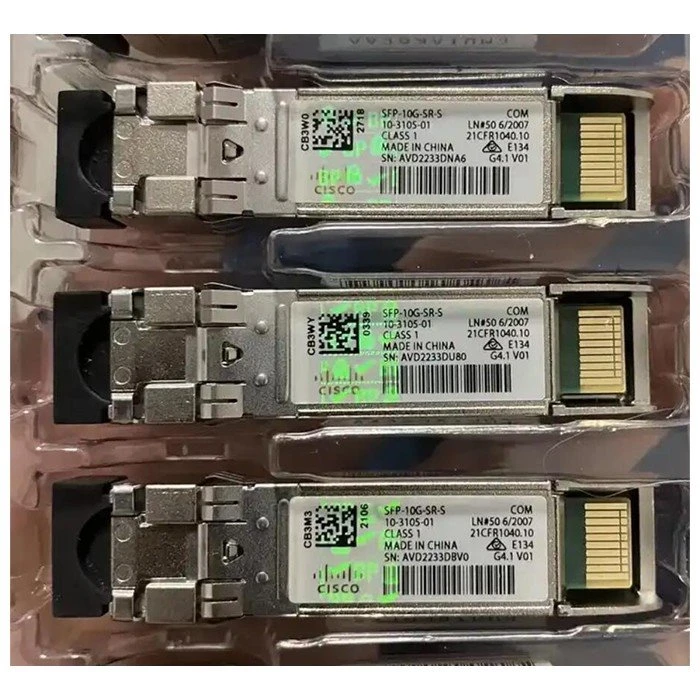
Products Description
The SFP port is an interface that realizes Gigabit optical and electrical signal conversion. Its main function is for signal conversion and data transmission. Its port complies with the IEEE 802.3ab standard (such as 1000BASE-T), and the maximum transmission rate can reach 1000 Mbps (some The SFP port of the switch supports 100/1000Mbps adaptive), so it is also called a Gigabit fiber port. The SFP optical module is an interface device that converts Gigabit electrical signals into optical signals. It is an industry-standard small pluggable Gigabit optical transceiver integrated module. Both ends of the SFP Optical Transceiver: One end is an SFP port, which is mainly plugged into network equipment such as switches, routers, and media converters to convert electrical signals into optical signals for transmission; the other end is an LC interface or RJ45 interface, which is mainly used to connect Optical fiber or network cable for data transmission.
Advantages
The SFP port is a hot-swappable I/O interface (referring to the input/output interface). It has strong flexibility and is suitable for a variety of network devices, such as SFP optical modules, Gigabit switches, etc., and can be used with 1000BASE-SX, 1000BASE-LX/LH, 1000BASE-ZX or 1000BASE-BX10-D/U ports for switching. In addition, the SFP port is backward compatible and supports 10/100/1000Mbps. In short, SFP ports have 4 major advantages:
● Supports hot swapping, which can reduce installation, maintenance and management time;
● Port flexibility;
● Rugged design enhances reliability;
● Compatible with 10/100/1000Mbps.
Cisco SFP Optical Transceiver
100 Base SFP
|
Models |
Specification |
Connector type |
|
GLC-FE-100LX-RGD |
1310nm, SMF, 10KM |
LC |
|
GLC-CE-100FX |
1310nm, MMF, 2KM |
LC |
|
GLC-FE-100ZX |
1550nm, SMF, 80KM |
LC |
1000 Base SFP
|
Models |
Specification |
Connector type |
|
SFP-GE-S |
850nm, MMF, 550M |
LC |
|
ONS-SC-GE-LX |
1310nm, SMF, 10KM |
LC |
|
GLC-EX-SMD |
1310nm, SMF, 40KM |
LC |
|
GLC-ZX-SM |
1550nm, SMF, 70KM |
LC |
|
GLC-BX-10U (SFP BIDI) |
1310nm-TX/1550nm-RX, SMF, 10KM |
LC |
|
ONS-SE-GE-BXD (SFP BIDI) |
1490nm-TX/1310nm-RX, SMF, 10KM |
LC |
|
GLC-BX40-U-I (SFP BIDI) |
1310nm-TX/1550nm-RX, SMF, 40KM |
LC |
|
GLC-SX-MM |
850nm, MMF, 550M |
LC |
|
GLC-LH-SM |
1310nm, SMF, 10KM |
LC |
|
GLC-T |
Electric port module, 100M |
RJ45 |
|
CWDM-SFP-1470 |
1470nm-1.25Gb/s-80KM |
LC |
|
CWDM-SFP-1490 |
1490nm-1.25Gb/s-80KM |
LC |
|
CWDM-SFP-1510 |
1510nm-1.25Gb/s-80KM |
LC |
|
CWDM-SFP-1530 |
1530nm-1.25Gb/s-80KM |
LC |
|
CWDM-SFP-1550 |
1550nm-1.25Gb/s-80KM |
LC |
|
CWDM-SFP-1570 |
1570nm-1.25Gb/s-80KM |
LC |
|
CWDM-SFP-1590 |
1590nm-1.25Gb/s-80KM |
LC |
|
CWDM-SFP-1610 |
1610nm-1.25Gb/s-80KM |
LC |
|
DWDM-SFP1G-34.25-100 |
1534.25nm, SMF, 100KM |
LC |
|
DWDM-SFP4G-56.55-80 |
1556.55nm, SMF, 80KM |
LC |
10G SFP+
|
Models |
Specification |
Connector type |
|
SFP-10G-SR-S |
10GBASE-SR, 850nm, 300m, MMF |
LC |
|
SFP-10G-SR |
10GBASE-SR, 850nm, 300m, MMF |
LC |
|
SFP-10G-SR-X |
10GBASE-SR, 850nm, 300m, MMF |
LC |
|
SFP-10G-LR-S |
10GBASE-LRM, 1310nm, 10/20KM, MMF |
LC |
|
SFP-10G-LR |
10GBASE-LR, 1310nm, 10/20KM, SMF |
LC |
|
SFP-10G-LR-X |
10GBASE-LR, 1310nm, 10/20KM, SMF |
LC |
|
SFP-10G-ER-S |
10GBASE-LR, 1310nm, 10/20KM, SMF |
LC |
|
SFP-10G-ER |
10GBASE-LRM, 1310/1550nm, 40KM, SMF |
LC |
|
SFP-10G-ZR-S |
10GBASE-LRM, 1310/1550nm, 40KM, SMF |
LC |
|
SFP-10G-ZR-S |
10GBASE-ZR, 1550nm, 40KM, SMF |
LC |
|
SFP-10G-ZR |
10GBASE-ZR, 1550nm, 40KM, SMF |
LC |

FAQ
Q: What is the difference between SFP port and RJ45 port?
Although the maximum transmission rate of the SFP port and the RJ45 port is both 1000Mbps, there are some differences between the two.
1. Different applications
For example, the SFP port on the switch needs to be equipped with an SFP optical module and uses optical fiber jumpers to achieve data transmission; while the RJ45 port on the switch can directly achieve data transmission through network cables.
2. Different transmission distances
The RJ45 port mainly transmits data through a network cable, and its maximum transmission distance is the maximum transmission distance of the network cable, which is 100 meters; while the SFP port requires an SFP Optical Transceiver to be connected to an optical fiber jumper for transmission, and its maximum transmission distance is the maximum transmission distance of the SFP optical module. The distance is 160 meters.
Q: Differences between SFP, SFP+, SFP28, QSFP+ and QSFP28
1. SFP
SFP is the abbreviation of SMALL FORM PLUGGABLE. It can be simply understood as an upgraded version of GBIC. Its volume is only 1/2 of the GBIC module. This design greatly increases the port density of network equipment. The transmission rates of SFP encapsulated optical modules include 155M, 1.25G, 2.5G, etc. The interface type is mainly LC interface, which is generally used in SONET/SDH networks, 100M/1000M Ethernet and other low-speed transmission applications.
2. SFP+
SFP+ has the same appearance size as SFP. The transmission rates of SFP+ packaged optical modules include 6G, 8G, 10G, etc. This package type includes 6G/8GFC optical modules, 10G optical modules, 10G electrical interface modules, 10G DAC high-speed cables and 10G AOC active optical cable. SFP+ series products are mainly used in 10G (10GBASE-SR) Ethernet links in data centers.
3. SFP28
SFP28 is an enhanced version of SFP+ and has the same size as SFP+, but it can support a single-channel 25Gb/s rate. SFP28 provides an efficient solution for 10G-25G-100G network upgrades to meet the continued growth of next-generation data center networks.
4. QSFP+
QSFP+ packaging can support 4-channel transmission at the same time, with a data rate of 10Gbit/s for each channel and a 40Gbps transmission rate through 4 channels. Compared with SFP+, the transmission rate of QSFP+ optical modules can be up to four times that of SFP+ optical modules. QSFP+ optical modules can be used directly when deploying 40G networks, thereby effectively saving costs while increasing port density.
5. QSFP28
The QSFP28 packaging type is produced to meet the needs of 100G applications. It can support 4-channel transmission at the same time, with a data rate of 25Gbit/s for each channel, and a 100Gbps transmission rate through 4 channels. It can meet the application requirements of 100G Ethernet (4×25Gbps) and EDR InfiniBand.
Hot Tags: sfp optical transceiver, China sfp optical transceiver manufacturers, suppliers, sfp for campus network, sfp for switch, sfp optical transceiver, sfp for active optical network, sfp for 2g, sfp for access network


