

In the realm of fiber optic technology, the choice between handheld and bench - top fiber optical tools is a crucial decision that can significantly impact the efficiency and quality of fiber optic installation, maintenance, and testing. As a trusted Fiber Optical Tools supplier, I've witnessed firsthand the diverse needs of our customers and the unique advantages that each type of tool brings to the table.
Portability and Mobility
One of the most obvious differences between handheld and bench - top fiber optical tools lies in their portability. Handheld tools, as the name suggests, are designed to be easily carried around. They are compact, lightweight, and can be taken to various job sites, whether it's a remote outdoor location for a new fiber optic cable installation or a cramped indoor space for network maintenance. For instance, a technician working on a large - scale fiber optic project in a construction site can conveniently carry a handheld optical time - domain reflectometer (OTDR) to different sections of the site to measure fiber length, attenuation, and detect faults.
On the other hand, bench - top tools are typically larger and heavier. They are intended to be used in a fixed location, such as a laboratory or a workshop. These tools require a stable surface and a power source, which limits their mobility. However, this fixed - location setup also allows for more precise and stable operation. For example, a bench - top fiber optic splicing machine is often used in a controlled environment where the splicing process needs to be highly accurate.
Functionality and Precision
When it comes to functionality, bench - top fiber optical tools often offer more advanced features and higher precision. Bench - top splicing equipment, for example, can perform more complex splicing operations with greater accuracy. These machines are equipped with high - resolution cameras and advanced alignment systems that can ensure a near - perfect alignment of fiber cores, resulting in lower splice loss. The splicing process on a bench - top machine is also more automated, reducing the risk of human error.
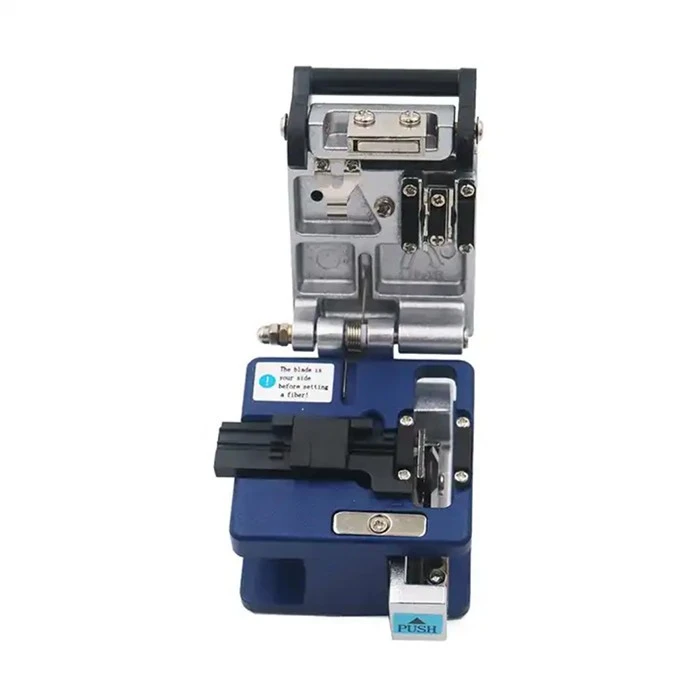
Handheld tools, while still capable of performing essential tasks, may have more limited functionality. A handheld fiber cleaver, for instance, is designed for quick and simple cleaving operations. It may not have the same level of precision as a bench - top cleaver, but it is sufficient for many on - site applications. Handheld OTDRs also have a more basic set of features compared to their bench - top counterparts. However, they are still very useful for quick fault detection and basic fiber characterization.
Cost
Cost is another important factor to consider when choosing between handheld and bench - top fiber optical tools. Generally, bench - top tools are more expensive than handheld tools. The advanced technology, higher precision, and additional features of bench - top equipment contribute to their higher price tag. For a small - scale fiber optic service provider or a DIY enthusiast, the cost of a bench - top splicing machine may be prohibitive.
Handheld tools, on the other hand, are more affordable. They are a great option for those who need to perform basic fiber optic tasks on a budget. For example, a handheld fiber optic inspection microscope can be a cost - effective solution for quickly checking the end - face of fiber connectors.
Ease of Use
Handheld fiber optical tools are generally easier to use, especially for beginners. They are designed with simplicity in mind, with intuitive interfaces and easy - to - understand controls. A technician can quickly learn how to operate a handheld OTDR or a fiber cleaver with minimal training. This makes handheld tools ideal for on - the - spot troubleshooting and quick repairs.

Bench - top tools, while offering more advanced functionality, may require more training to operate effectively. The complex settings and procedures of a bench - top splicing machine, for example, need to be mastered to achieve optimal results. However, once the operator is familiar with the equipment, the benefits of using a bench - top tool can be significant.
Applications
The choice between handheld and bench - top fiber optical tools also depends on the specific application. Handheld tools are well - suited for fieldwork, such as cable installation, maintenance, and fault detection. They are essential for technicians who need to work in different locations and perform tasks quickly. For example, in a telecommunications network, a technician can use a handheld power meter to measure the optical power of a fiber optic link on - site.
Bench - top tools are more suitable for laboratory testing, research, and high - precision manufacturing. In a fiber optic manufacturing facility, bench - top equipment is used to produce high - quality fiber optic components. The stable environment and advanced features of bench - top tools ensure the accuracy and consistency of the manufacturing process.
Our Product Offerings
As a Fiber Optical Tools supplier, we offer a wide range of handheld and bench - top tools to meet the diverse needs of our customers. Our Fiber Optic Tool Kits include all the essential tools for fiber optic installation and maintenance. These kits are available in both handheld and bench - top versions, allowing customers to choose the one that best suits their requirements.
Our Fiber Cleaver Kit is a great option for those who need to perform fiber cleaving operations. We offer both handheld and bench - top cleavers, each with its own unique features and advantages.
For fiber optic splicing, our Fiber Optic Splicing Equipment includes high - quality bench - top splicing machines as well as portable handheld splicing devices. Our splicing equipment is designed to provide reliable and accurate splicing results, whether you are working in a laboratory or in the field.
Conclusion
In conclusion, the differences between handheld and bench - top fiber optical tools are significant in terms of portability, functionality, cost, ease of use, and applications. Handheld tools are ideal for on - site work, offering portability and ease of use at a lower cost. Bench - top tools, on the other hand, provide higher precision and more advanced functionality, making them suitable for laboratory and manufacturing applications.
If you are in the market for fiber optical tools, we encourage you to explore our product offerings. Whether you need a handheld tool for quick on - site repairs or a bench - top tool for high - precision work, we have the solution for you. Contact us to discuss your specific requirements and let us help you find the right fiber optical tools for your project.
References
- "Fiber Optic Communication Systems" by Govind P. Agrawal
- "Optical Fiber Technology: Principles and Applications" by Wayne C. Youngquist