


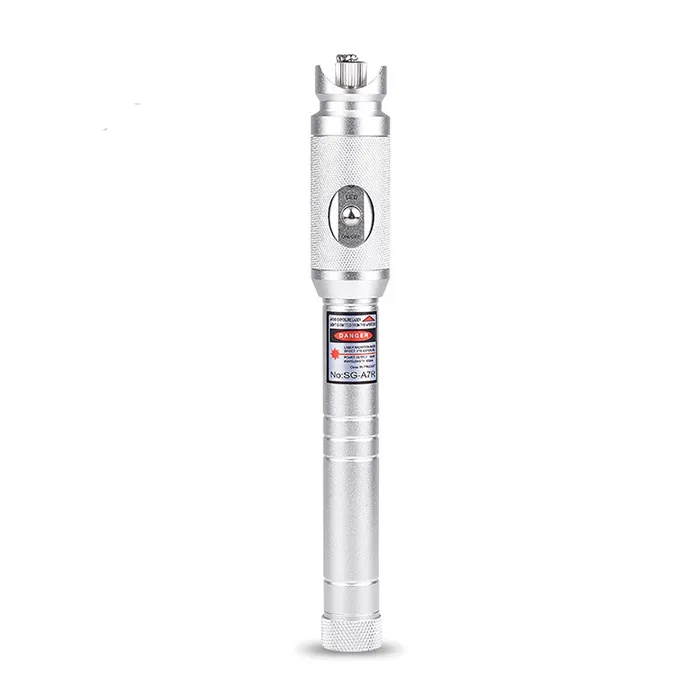


Products Description
In our communication construction, we often use pen type visual fault locator, which can be used to detect fiber optic breakpoints. The appearance of red light pens is generally relatively small and convenient to use. This fiber optic visual fault locator is designed with a metal material appearance, which will have a good grip texture. Its silicone dust cap is not only very sturdy and won't allow dust to easily enter, but also won't break when the dust cap is twisted and pulled hard. We only need to gently open the dust cap when using it and then close it again. During testing, the dust cap was still tightly closed.
Specification
|
Output power |
5mW, 10mW, 15mW, 20mW, 30mW |
|
Output distance |
5KM, 10KM, 15KM, 20KM, 30KM |
|
Wavelength |
650nm |
|
Fiber interface |
2.5mm common interface |
|
Battery |
No.5 battery X2 |
|
Working temp |
-10 ∽ +60 |
|
Stock temp |
-20 ∽ +70 |
|
Weight |
173g (with battery) |
|
Pen sizes |
160mm*27mm*27mm |

Practical operation
The first step is to take a group photo of the tools used when using a red light pen for detection - including a red light pen, fiber cleaning pen, jumper, and LC adapter. The general design of the red light pen interface is 2.5mm, which is suitable for FC, SC, and ST interfaces. However, since the outer diameter of the LC connector plug is 1.25mm, it needs to be equipped with a 2.5-1.25mm adapter. When testing, such an adapter should be installed on the red light pen first.
● Equipped with powerful light sources
Next, we need to turn on the machine. We tested the start mode, long press for 2 seconds to turn it on and turn it into a constant light mode, and then press again to turn on the flashing mode. The constant light mode is like this ↓ visible to the naked eye under high light of white cardboard, where red light can be seen in a circular shape. In fact, the eyes can see it more clearly. This red light is thanks to the use of imported laser chips, ensuring a stronger light source.
● Connector cleaning
In order to perform better testing, we first use a fiber optic cleaning pen to clean the connector. Insert the cleaning pen into the connector and gently press it. After cleaning, you can hear a "click" sound prompt, so that the port of the connector will become shiny and clean. Usually, many users do not pay much attention to such preliminary operations, but it is still recommended that everyone clean the port.
● Detection fiber
After cleaning the interface, we need to start detecting the fiber optic line break point situation. We have tried inserting this red light pen into four different ports, which is generally quite smooth and does not have any resistance. However, everyone should also pay attention to the detection, especially when encountering ports of LC type, and do not use too much force to avoid damaging the plug core.
Operation method: Press for 2 seconds to turn on the device. Turn on the constant light mode to check if the fiber optic jumper is connected and intact. If there is a red light leakage at a certain point in the fiber optic jumper, turn on the flashing mode (press the button again) to quickly find the fault point of the fiber optic.
A. When detecting fiber optic breakpoints, one end of the fiber is connected to a red light pen, and the red light pen is normally turned on. It is found that there is no red light emitted from the other end, but a red light leakage is found in a certain part of the fiber optic center, indicating that there is a breakpoint in the fiber optic here. It should be reconnected or replaced.
B. Searching for fiber bending
When there is bending in the optical fiber, it will greatly increase the red light loss and reduce the detection efficiency. The use of KFL-11P red light pen can effectively locate fiber bending points for quick and effective correction.
C. Quick identification of optical fibers
When facing hundreds or thousands of optical fibers in the computer room, finding the target fiber seems to be a challenge... The red light pen can quickly find the desired target fiber from the messy pile of optical fibers based on the emitted red light. This feature is often used when installing network broadband at home.
We can take a look at the final detection results. When the red light passes through the optical fiber and shines out at another port (it can be clearly seen on the white cardboard that the red light shines out from the other end of the optical fiber, which is more clearly visible on site), we can choose the red light pen's constant light or flashing mode according to the initial instructions. You can choose according to the actual operating needs.
FAQ
How to check if the fiber optic connection is normal?
pen type visual fault locator is a commonly used test for checking the continuity of optical fibers within a short distance range. Red light is emitted at one end of the optical fiber, and if the opposite end has weak or no red light, it indicates that the optical fiber may be damaged.
If it is necessary to accurately determine the transmission performance of the optical path, an optical power meter needs to be used for testing. For example, when the luminous power of a certain optical device is -10dB, and the received optical power of the opposite end beyond 20km is -99dB, it indicates that the optical fiber has been interrupted; If the received optical power is -29dB, it indicates abnormal losses in the fiber optic line.
Hot Tags: pen type visual fault locator, China pen type visual fault locator manufacturers, suppliers, Fiber Cleaver Kit, Optical Light Source and Power Meter


